
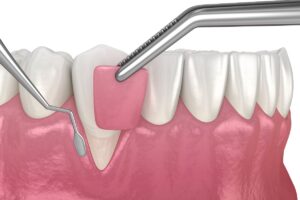
Whether you’ve already noticed the exposed roots of your teeth, or your periodontist has found areas in your smile that have receded enough to require intervention, a gum graft may be necessary to restore your oral health. The good news is that not only will this procedure help protect your smile, but it’s also nothing to worry about! Here’s a closer look at the three different types of gum grafts, and how they can benefit your oral health.
What is a Gum Graft?
A gum graft is a procedure performed by a periodontist to restore gum tissue that has receded or pulled away from the base of the tooth due to gum disease, often revealing its root structure below. Using tissue from a different area of the mouth, the exposed area is then covered, and the tissue is sutured into place where it eventually heals to becomes part of your periodontal tissue. This protects the tooth, reducing your risk of cavities and sensitivity below the gumline.
The 3 Times of Gum Grafts
There are three main types of gum grafts, each of which can be done to suit the specific needs of the patient. Here’s a closer look at them, and why your periodontist may recommend them.
Free Gingival Grafts
A free gingival graft is performed using tissue from the roof of your mouth that is then attached to the gum area. It is ideal for patients with thin gum tissue who may need additional reinforcement to bulk it up.
Connective-Tissue Grafts
Connective tissue grafts are the most common type of gum graft and are an excellent option for patients with exposed tooth roots. During your procedure, your periodontist will cut a flap of skin from the roof of your mouth and take tissue (known as subepithelial connective tissue) from underneath. It is then attached to the gums surrounding the tooth’s roots. Once complete, the flap in the roof of your mouth is also sutured closed so both areas can heal in tandem.
Pedicle Grafts
This graft takes tissue directly from the gums instead of the roof of the mouth. To perform it, a flap called a pedicle is partially cut from the gums, and then either pulled over or down to cover the tooth’s roots. This is an ideal option for those who already have sufficient gum tissue surrounding the tooth.
Which Type of Graft is Right for Me?
Your periodontist is an expert at treating gum tissue and is the best person to determine which type of gum graft is best for your smile. During your consultation, he will examine your teeth and gums, and decide which procedure will be the most effective way to restore your gorgeous grin. Rest assured that no matter what is recommended, it will always be in the best interest of your oral health.
Remember, if gum disease is causing you dangerous gum recession that could eventually lead to tooth loss, a gum grafting procedure from your periodontist could help protect your teeth and restore your beautiful smile. To learn more about this treatment and see if it’s right for you, schedule a consultation for gum disease therapy with your periodontist today.
About Dr. Barnett
Dr. Andrew Barnett earned his undergraduate degree at the University of Michigan and his dental doctorate at the University of Pittsburgh. He then earned his master’s degree and certificate in periodontics from the University of Michigan. Today, he is proud to hold memberships in the American Dental Association, the American Academy of Periodontology, and the Texas Dental Association. To schedule a consultation for gum grafting at Park Lane Periodontal & Implant Group, visit our website or call us today at 214-691-2614.